Sunday, January 16, 2011

Individual Reflection

I believe that the purpose of a school and my place in it as a teacher is to provide the knowledge that will enrich the lives of students and to make learning a continuous process for them while expanding their imaginations to enable them to appreciate the many things life has to offer.
Reading and math are the critical subjects. They are the doorway to all other learning. They are the essential tools that students will need throughout their lives. A well-rounded student will also have to know history in order to learn from the past and have some concept on where our present is leading us. Further, in order to be good citizens it is important for students to have some knowledge of civics to understand their role in society. It is also desirable for students to know something about science in an age when technology is so important in everyday life. It is also my belief that a well educated student needs some exposure to art and music.
It’s been my experience that my students’ learning has been enriched greatly by field trips to cultural institutions. An especially powerful experience my class had was on the occasion of our field trip to the National Museum of the American Indian where they gained powerful insights into the many cultures of Native Americans.
In addition to learning concepts, students should be aware of how those concepts apply or are useful to us in everyday life. For example when learning math, students should be aware of the importance of understanding the use of money in the supermarket; of being aware of price and affordability of products they use; they should be able to calculate the amount of time it takes to run a mile or to drive to Baltimore or Washington from home in a given speed.
It troubles me when a sixth grader does not know basic multiplication or division facts. I see every day in class how students cannot solve math problems because they do not know these basic math facts. The other day I gave my sixth grade students a blank multiplication chart like the one below:

I was surprised to see how many had difficulty completing the chart in the allotted time. This made me realize that they did not have the skills supposedly learned in previous years to successfully perform this task.
Reading is a key to all other learning and success in life. I am always aware of my students’ reading levels. I test my students by using Formative Assessments written by the County, and the Scholastic Reading Inventory Test to gauge their progress. However, I have some doubts that this is really a fully accurate measure of a student’s ability to read. As a child, I was encouraged to read by my parents and as a result developed a love of reading. Based on my own experience, I am convinced that without the incentives to read that I was provided with, I would not have pursued reading with such enthusiasm. In my own class I attempt to provide incentives to my students. We have a very attractive class library from which the students choose reading material each day for our 15 minutes of silent reading in class. I try to encourage parents to understand how important it is to stimulate their children’s to become readers. I find that when we are on the same wave length, I can make substantial progress.
If I were to use one of the five narratives from Postman, I would say that my job is like;
Word weavers/word makers
• Language is the driving force of what makes us human
• The purpose of schooling is to provide students with the mastery of language (Postman, pp.17-19)


Sunday, November 14, 2010

Individual Reflection

For the post observation we sat in Ms. M’s class. We were surrounded by student work, anchor charts, and a wall just for the students’ work.

We sat across from each other as I conducted the post-observation. During the conference Ms. M was very energetic, did not hem or haw and answered all my questions like a pro. I started by asking her what she thought went right or wrong with her lesson and if there was anything she would have changed. Her answer was nothing. She was working on her vocabulary lesson, “Bringing Words to Life”; a power point that illustrates the high frequency vocabulary words of the story to be used was all planned out and had a reinforcement activity back at their desks to work on. The students were energetic and had been taught well how to go back to their seats and work on the reinforcement page of their vocabulary words.


She explained to them what was expected of them.
We were very comfortable. It was evident working with her that she was very comfortable with herself. During her observation, she was very involved with the students and enjoyed what she was doing. She was well prepared and her instruction showed it. The students were also very engaged with the lesson.


One area that I thought could be improved is giving the students a little more time to answer her questions about the vocabulary words. I feel she could have used a timer and given them a specific amount of time to turn and talk about the vocabulary words. One area that I was really impressed with was the use of hand motions to show the students when to come back together after discussing. Another aspect that I was impressed with was the use of a bell to get the students to calm down and come back together.
I used the pre-observation conference focus sheet of the Charlotte Danielson Frame Work for Teachers. It gave me insight into her class.
I was constantly praising her for the way she went about the lesson and how she had control of her students. Talking with the teacher, I could see that she was very confident of the way she presented her lesson.
In conclusion, I was very impressed with Ms. M’s lesson and I would recommend that she continues the same way in the future. While I was doing the post-observation I felt that I was encouraging her at times to continue to teach the material the way she was. I did encourage her to give her students more time or set a time limit when the students turn and share their answers. There was a collaborative approach with Ms. M on how she can improve her lesson. I feel this is important because as a novice teacher, she can benefit from other ideas.

Saturday, October 2, 2010

Room Arrangements

This past week I became more aware of different room arrangements in the school in which I teach. Unlike the common classroom arrangement which I experienced as a child where walls set classroom boundaries, my school is an open area school where we “build” our classrooms out of furniture. The following image of the entry way to our Area III illustrates how bookcases and blackboards serve to demarcate classroom boundaries. To the right and left of this entry way there are two Fifth Grade Special Needs classrooms and two Sixth Grade general education classrooms.


At my school we have a large Special Needs population. One Special Needs teacher chose to arrange desks in her room clustered in groups of five. The second teacher in this classroom placed her desk in the back of the room. The students’s desks were close to the front of the room. I found that this arrangment made it difficult for me to navigate around these clustered desks to get to the board. There was a round table where small group instruction was held. I would say that this classroom was arranged in a very traditinal way. In the Special Needs classroom, the computers were set along the far wall. They were easily accessible to the students; however, I found that because of the crowding of desks students did not have adequate room to work.


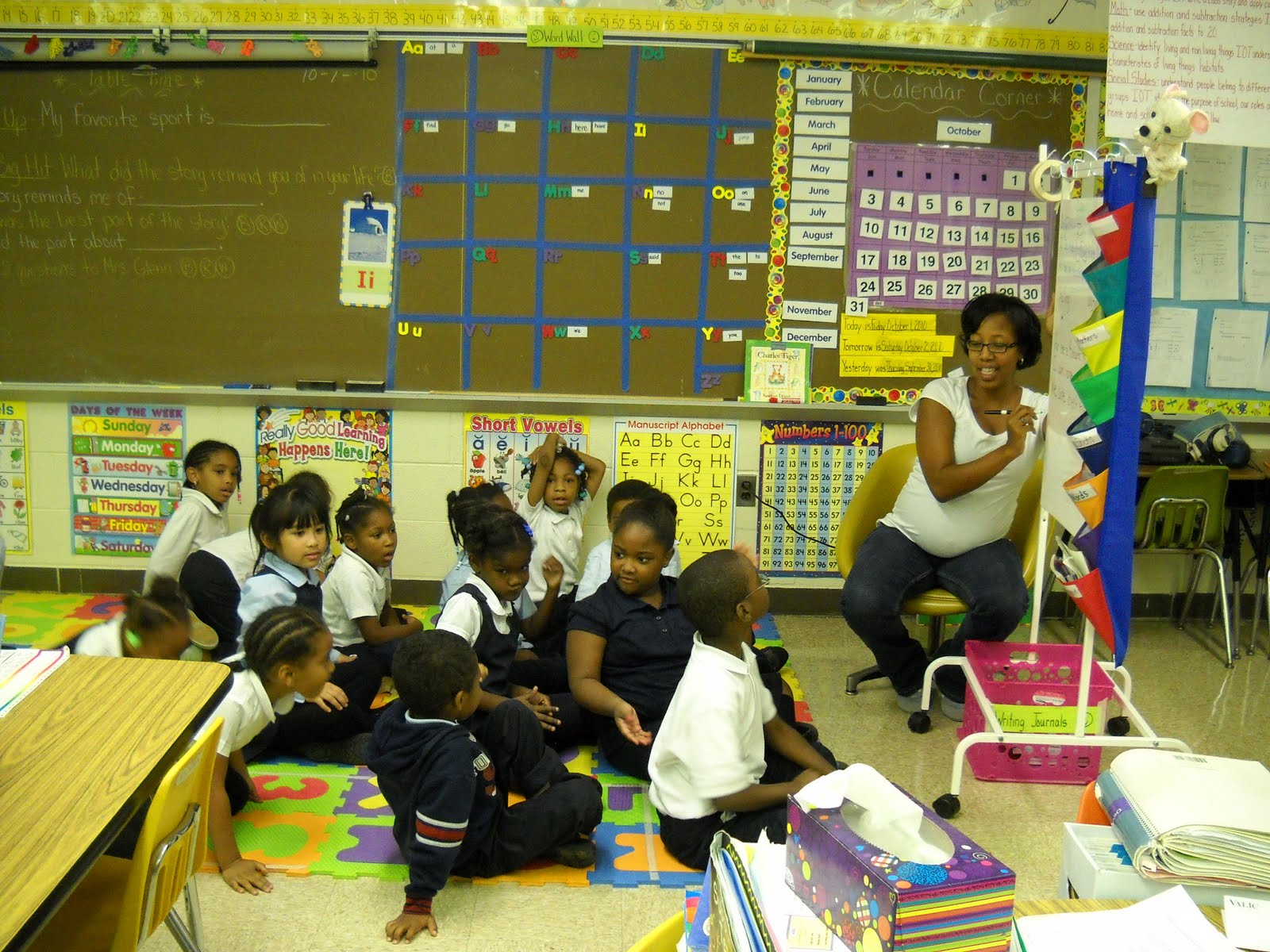
In a First Grade class, the teacher had set up her classroom with long tables in a traditional manner. As is illustrated in the image below, there is spaciousness in this classroom that makes student learning very comfortable. This classroom is easy to move around in for both students and teacher and allows students to work well collaboratively. In addition to the work areas, the teacher had an area where she did her group work.


Another classroom had an area set up for cooperative learning. I found this area very hard to navigate because of the proximity of furniture in the room. The seating arrangement was cramped making it difficult for students to concentrate on their own work. It would be difficult to supervise students at this reading center because of the lack of room. However, when I compared it to another classroom, I noted that the computers were easier to access and that the small group center was more conducive to student learning.

My own classroom is arranged in a U shape with an entrance for me to get to my work table. My desk located in the back of the room in the left hand corner.
I also have a long table in the back of the room which I use when working with small groups in reading and math. I find that this arrangement makes for a spaciousness that allows me to reach students easily and keeps students’ concentration on their own work at a maximum. I have used this classroom arrangement for the past two years. I am one of the few teachers in the building that is fortunate enough to have a window in my teaching space.

The way teachers arrange their classrooms should be a personal choice. However, teachers should know what works for other teachers and be flexible enough to change classroom arrangements if they do not seem to working in the way intended. Whatever choice a teacher makes, the classroom should have an inviting climate to encourage student learning. It is imperative to avoid crowding. There should be ample space between students’ desks, special work areas, and computer stations, providing for an easy movement from one area to another. Colleagues told me that within the different classroom arrangements, they provide special seating for students who need to be closer to the board for reasons of hearing or seeing, and for those students who need closer proximity to the teacher’s desk because of behavioral problems.
Last year our school received 2.1 million dollars from the State of Maryland for classroom renovations which included putting up walls to separate classes. Although it has been decided to go ahead with these renovations, to this date there has been no action taken. The putting of walls would change in a dramatic way our teaching styles. Principal and teachers are waiting eagerly for this change to come about and replace the open space.


Sunday, August 22, 2010

Change

Change: Based on your understanding of the Marzano reading, which of the 21 responsibilities and day-to-day management of a school are most necessary for second-order change? How does the complexity of second order change demand a very thoughtful and flexible administrator?

In chapter five, Two Types of change, Marzano lays out seven steps to be successful in second order change:
1. Knowledge of Curriculum, instruction, and Assessment-The principal has to be aware of what the curriculum is asking for, know what the instructional and assessment practices are of then innovation and provide guidance where necessary.
2. Optimizer-The principal has to be able to force behind the innovation and believe that his/her staff will follow.
3. Intellectual Stimulation-Being able teach the staff what he or she knows about the innovation.
4. Change Agent-The principal is able to challenge the status quo.
5. Monitoring/Evaluating-He/she is constantly watching and checking for the work being done.
6. Flexibility-Being able to put his/her input into the discussion when needed
7. Ideals and beliefs-That the innovation is based on their beliefs.

I feel that these seven second order changes are important because no principal can be successful if they have to use all twenty one of the first order.
It is interesting to look back at the week two Balanced Report that I took. When I got my results, I was surprised that I fell into second order. It was an interesting exercise and it showed me how hard it is to run a school day after day. One area that I scored low on was flexibility. I have to learn how listen to staff and be able to listen to other ideas.
An administrator in my opinion has to be able to listen to his/her staff and take their ideas to be successful. Running a day to day operation is not easy and to borrow a nautical term it “takes all hands on deck” to be successful. Marzano states that “When involved in the day-to-day first-order changes and corrections that face a school faces, the school leader must attend to all 21 responsibilities as regular of managing the school. When involved in second-order change initiatives that are dramatic departures from the past, the leader must emphasize 7 responsibilities.” (Marzano 2005) It is the dramatic departure from the norm that makes it difficult.

Culture

Culture: What impact does the creation of a positive school culture have on school reform?

“A school culture influences the ways people think, feel, and act.” (Peterson n.d.) School culture is very important in many ways. One way is making the school an inviting and welcoming place. Without a positive school culture, school reform would be very hard. The students, teachers and administration have to work together to make a school an interesting place to grow and learn. My school is divided into different areas. My area is Area III where there are two sixth grade content area teachers, and two students with disabilities teachers. When I walked into the area, the color on the bulletin boards and the teachers rooms makes me smile, I was happy to be there. I feel, just Area III, we have a positive culture for the kids to learn in.
I feel school culture and school reform go hand in hand. In the SEDAL Voices from the Field: Success in School Reform , the narrator states, “An environment of trust is vital for the risk taking that is not only inherent, but also encouraged in successful school reform programs. School leaders are often the most important people in setting the proper atmosphere for learning. They are called upon to listen and pay attention to what is happening at every level inside the school. Dr. Hord goes on to say, “Leaders are highly important in the establishment of a context for change. While they do not do all the work by themselves, what they do is to engage the staff with them in sharing a vision of where they want to go and how they're going to get there so that they learn together."
I feel you cannot have one without the other. In Marzano’s Doing the Right Work he quotes Elmore. Elmore states “that the school reform effort in the United States is plagued by falsehoods, one of which is that schools fail because teachers and administrators don’t work hard enough.” (Elmore 2003) This is where I feel a positive school culture comes in. Staff has to work together to be successful.
"Culture does not change because we desire to change it. Culture changes when the organization is transformed; the culture reflects the realities of people working together every day."Frances Hesselbein
The Key to Cultural Transformation, Leader to Leader (Spring 1999)

References:

Peterson.K.D. Positve or Negative. JSD Summer 2002 National Staff Development Council 15

Marzano R. Two Types of Change. School leadership that Works from Research to Results;
McREL 2005 Denver Colorado

SEDAL Voices from the Field

Sunday, August 1, 2010

Week 3-Post 2

•How has what you have learned so far in this course shaped your concept of an effective leader?
•Based on what you have learned so far, what are the top 3-5 characteristics you believe a successful principal must possess?

As I was rereading this week, I thought to myself how much I have learned this past three weeks, becoming a leader is not easy. From all the readings, I realized a lot of the leadership qualities theorists were talking about, how much I already do. Covey stands out for me because a lot of his habits hit home. I can relate to Habit 2. This is the ability to control one's environment, rather than have it control you, as is so often the case. Self determination, choice, and the power to decide response to stimulus, conditions and circumstances. In my school, which is an open space school, I cannot let what goes on in other classes bother me. I have to focus on what is going on in my room. Habit 6 - synergize®
Covey says, "this is the habit of creative co-operation - the principle that the whole is greater than the sum of its parts, which implicitly lays down the challenge to see the good and potential in the other person's contribution." Everyone is working together to succed at a certain goal.
I keep 0n going back to the reading we did by Murphy, and the quote that he saw on the door when he got his new job, "Notice
The objective of all dedicated department employees should be to thoroughly analyze all situations, anticipate all problems prior to their occurrence, have answers for these problems, and move swiftly to solve these problems when called upon. However...When you are up to your ass in alligators it is difficult to remind yourself that your initial objective was to drain the swamp." (Murphy 2007)
This quote shows me how I need to wear different hats in order to be successful as a leader.

In a article recently published by Education week examining effective school principals it found that "high student achievement is linked to collective leadership": the combined influence of educators, parents, and others on school decisions." (Education Week 2010) Leadership has to a combined effort because teachers and administrators have to work together to get results. This goes back in what I stated that there has to be synergy
among the staff.

As I finish week three, the big picture is coming into focus. I can see that being a leader is not an easy job. As I state on the voice thread, there is going to be failure in many places. I feel you cannot just put someone in a situation everything is not going to go smoothly at first. One quality I feel that a successful principal must have is the ability to overcome failure. Another quality that i think is very important is communication. A principal has to be able to communicate with her/his staff, the community around them and the district office administrators. Another trait that is very important is the ability to ask questions. Murphy states " Administrators need to recognize and acknowledge their ignorance and then take action." (Murphy 2007) And the most important trait that a authentic leader has to have a vi son which has to be carried out by the rest of the teachers. Murphy writes, "A leaders vision is the grain of sand in the oyster, not the pearl." (Heifetz and Sinder, 1987, pp. 194, 197) I have come to realize that I possess a few of these characteristics but I have more work to do.

In conclusion I ask myself if I have answered Evans three questions for being an effective leader:


  1. How do I define my role as a leader?


  2. What inspires the best in staff?


  3. What are my strengths?

I have just begun to answer those questions and by the end of this course I hope to have them answered.
References:

Evans, R. (2007). The authentic leader. The Jossey-Bass Reader on
Educational Leadership, 135-156, San Francisco: Jossey-Bass.

Steven Covey, Author of 7 Habits of Highly Successful People – (The Transformational Leadership Report, 2007)

Study: Effective Principals Embrace Collective Leadership. (2010,July). Education Week (Vol 29, Issue 37). Education Week.

Murphy, J. T. (2007). The UHEROIC SIDE OF LEADERSHIP-NOTES FROM THE SWAMP. The Josey-Bass Reader on Educational Leadership, 51-62 San Francisco, CA: Jossey-Bass.

To view the article click here:
http://www.edweek.org/ew/articles/2010/07/23/37principal.h29.html?tkn=TPSFHsBZuH0HBDh9RLJDV9CKGg%2Fwv9g%2BGhCo&cmp=clp-edweek

Week 3 Reflection-Post 1

How do the results of the balanced leadership profile inventory compare with your own self-assessment of the 21 Responsibilities of a School Leader? Consider your top seven strengths and top seven areas of improvement from your self-assessment. How do they correlate with student achievement (Fig 4.2, p. 63 of Marzano text)?

It was very interesting doing the self-assessment and to compare it to the balanced leader survey. I did a comparison chart between the two. It made me think like a principal and the things I found out about myself were very enlightening. In the self-assessment I gave myself a 3 in communication. In the leadership profile it averaged my score to 3.67. This was a surprise for me because I always thought of myself as a great communicator. This illustrates to me that I need to communicate my ideas better. In figure 4.2, p.63 of Marzano text, the correlation with student Academic in communication is.23. These numbers show that I do not communicate with our students the way I should. Another weak area that I gave myself a low score is Involvement with Curriculum, Instruction and Assessment (CIA). On the leader profile it was I was given a score of 4.75. For student achievement is .25. I feel that this means that more work has to be done studying the curriculum in order for our students to be successful. It was interesting to find out that one of my weaknesses is Situational awareness. In the self assessment I gave myself a three as if I was a principal. The balanced survey was along the same lines, it scored me on a 3.6o. Once again, it made me aware that as an effective principle I have to be aware of what is going on in my building. Compared to Marzano, this is an area which is very high with student achievement. Situational awareness allows the student problems to be put to rest before they erupt into bigger problems. Flexibility is another area in which I need to improve. I am not comfortable at times with other people’s ideas after I think I have come up with a good one. However, I have become better in allowing change in my work by others and again that is very important in becoming a strong leader. please see my chart using this link:

https://docs.google.com/document/edit?id=1GEIwbMCTwPh7Slj_PWsmae5sHboZeTKn70Y_Ja1GFo8&hl=en&authkey=CIm04Fk#

Marzano, R. J., Waters, T., & McNulty, B. A. (2005). School leadership that work From research to results. Alexandria, VA: Association for Supervision and Curriculum Development